
Sourdough has become a wellness icon …
People believe it is healthier than regular bread, especially for blood sugar, but is it ?

I remain committed to empowering you with clear scientific explanations and guidelines around Gut Skin Nutritional and Functional Health.
The scientific concept around healthy fermented foods is real, but it depends on whether your bread was actually fermented !
Many supermarket "sourdoughs" are not.
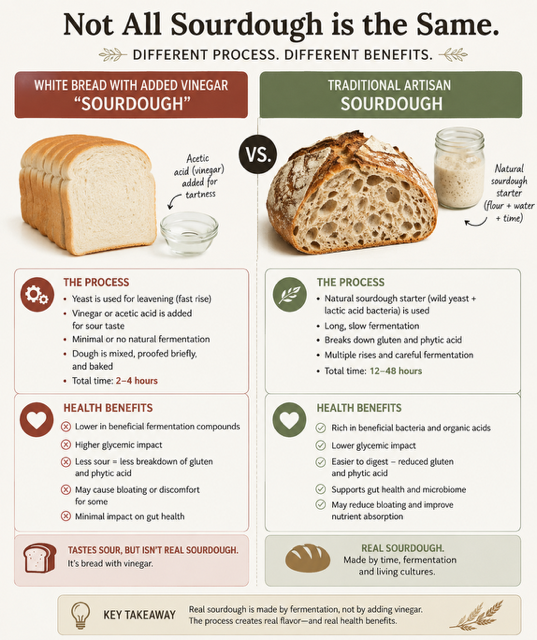
Traditional Sourdough is considered healthier than standard commercial bread
Its slow fermentation process breaks down the complex starches and gluten offering several distinct advantages
better blood glucose control
easier digestion
higher vitamin and mineral absorption especially iron and zinc
artisan sourdough contains fewer additives.
The human studies
Liljeberg and Bjorck (Am J Clin Nutr 1997) showed that adding lactic acid or propionate to bread lowered after meal glucose and insulin in healthy adults.
The acids do the work.
Ozer and colleagues (Wien Klin Wochenschr 2023) tested 43 women with gestational diabetes and 38 healthy pregnant women.
Same breakfast, same carb dose, different bread.
and the results ..white wheat caused a 45 percent more insulin and 9.6 percent more first-hour glucose than sourdough whole grain.
In both groups, the difference was the bread.

The industry problem
In both Australia and the United States, "sourdough" is not a regulated term. Manufacturers can label any bread sourdough.
Real Bread Campaign auditors in the UK have documented widespread use of commercial yeast, added vinegar or acetic acid, and "sourdough flavoring" in loaves sold as sourdough. The bread is leavened in roughly two hours, then dosed with acid to mimic the tang of a long ferment.
and why this matters
Added vinegar is not nothing.
Liljeberg 1997 showed adding acid to bread produces some glucose-lowering effect. However, it does not replicate full sourdough fermentation, which produces both lactic and acetic acid in specific ratios plus slow modification of the starch itself. Quality sourdough in the Sydney market can ferment for up to 48 hours.
Commercial "sourdough" with added vinegar gets you a fraction of the benefit.

Authentic sourdough should always list: flour, water, salt and starter
If the label says yeast, vinegar, acetic acid, or "natural flavor," the bread was not fermented in the traditional sense.
Hybrid labels ("made with sourdough starter" plus commercial yeast) get some flavor compounds but skip most of the ferment.
My takeaway
The glucose effect of sourdough is real and is one of the more rigorously documented benefits in fermented foods. But the benefit lives in the fermentation, not the label.
Check the ingredient list.
If it has yeast or vinegar, you are eating fast bread with a marketing claim.
References
Liljeberg, Am J Clin Nutr 1997 · Ozer, Wien Klin Wochenschr 2023