
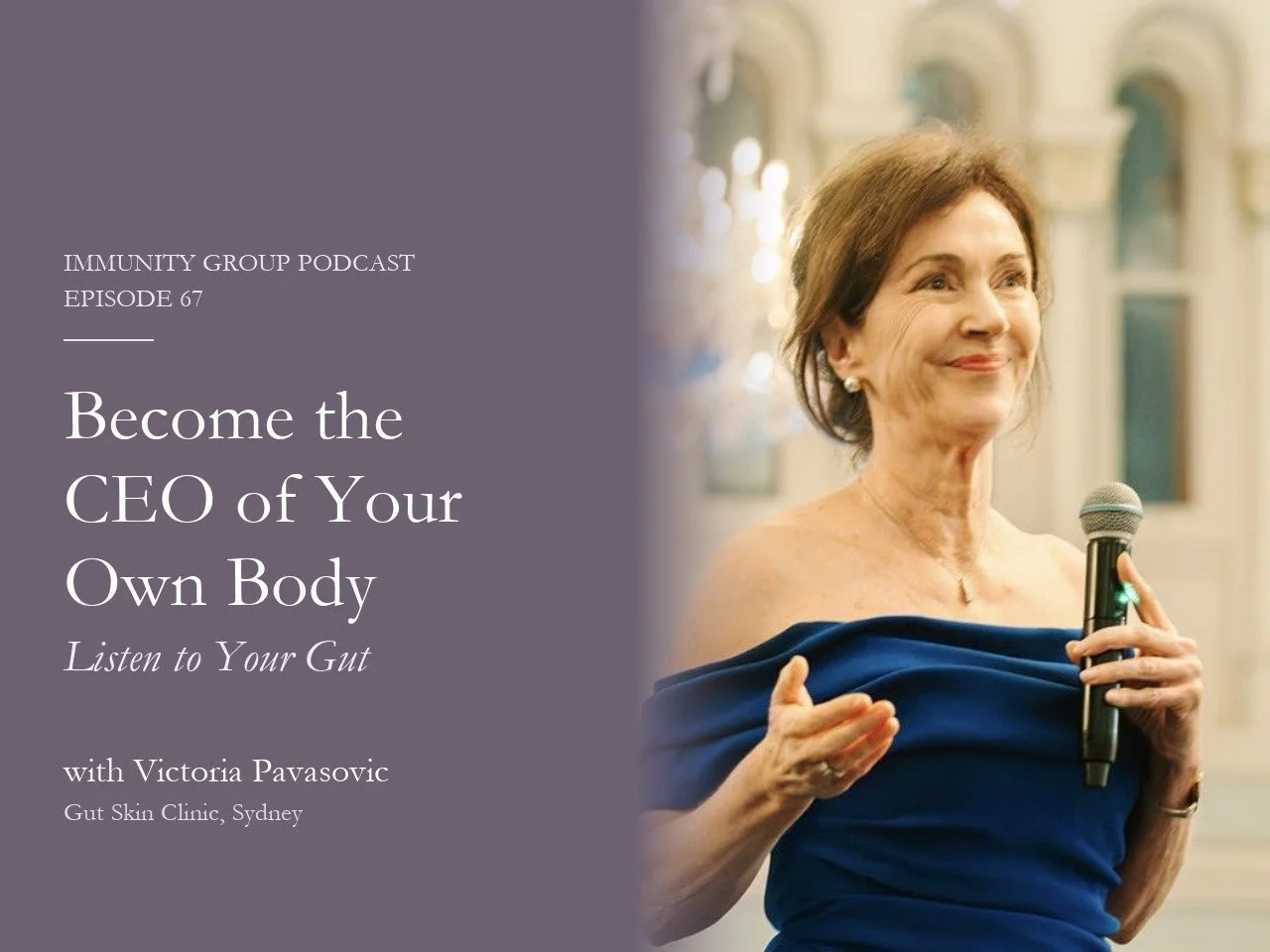
Victoria joins the Immunity Group podcast (Episode 67) to talk about the gut microbiome, testing, and where to begin.
Watch the full conversation below, or scroll down and play just the section you’re interested in.
Prefer to listen? Find the episode on Spotify.
In this episode
Welcome: the Food Allergy Gala and making gut science digestible
The host, Nina, introduces Victoria Pavasovic as a registered nurse, functional nutritional medicine practitioner and microbiome practitioner who was keynote speaker at the Allergy Microbiome Foundation gala night, a fundraiser for food allergy research in general practice. Victoria says her aim is to turn complex microbiome science into simple English so that patients can see why it is relevant to them.
Watch this section (starts at 0:00)
Learning from the world's best: teaching at Kamalaya, Thailand
Victoria describes travelling to wellness resorts to meet and learn from other practitioners, and talks about Kamalaya Resort on Koh Samui in Thailand, which she says combines Eastern and Western approaches to care. She says she goes there every year to run an educational series and will be presenting there again in about three weeks.
Watch this section (starts at 1:48)
From "the pipe" to its inhabitants: how gut science changed
Victoria recalls 12 years in the metabolic health, liver transplant and gastroenterology unit at Royal Prince Alfred Hospital in Sydney, when the gut was investigated as a pipe by looking at its lining with a camera. She says research in the last 10 years has turned to the microbes that live in the gut, mentions 83,000 peer-reviewed papers, and describes each person's microbiome as being as unique as a thumbprint and affected by lifestyle and food.
Watch this section (starts at 3:36)
Microbiome testing: what it can and can't tell you
Asked about myths around testing, Victoria explains why she uses the Microba test, mentioning its NATA accreditation and its shotgun metagenomic method, which looks at individual species and strains. She states that microbiome testing is not a diagnostic tool and says results should be read by an experienced practitioner alongside clinical insights on the patient.
Watch this section (starts at 6:21)
Stool banks, faecal transplants and the garden analogy
Nina describes the Toilet Museum in Suwon, Korea, and the stool bank that funds it and supplies more than 60 hospitals. Victoria notes that Professor Borody already performs faecal microbiome transplants in Australia, then uses a garden analogy: a seed will not grow in soil that is not watered and fertilised, so she says the gut ecosystem and food come first, before probiotics, fibre or transplants.
Watch this section (starts at 9:40)
Victoria's story: the illness that changed her practice
Victoria says that 25 years ago, while working and teaching in emergency and intensive care, she developed a progressive autoimmune condition with skin and joint manifestations. She describes how studying the cause of her own illness led her into preventative health and shaped the way her clinic works with people, and says she has been in remission over that period.
Watch this section (starts at 15:03)
Where to begin when you feel overwhelmed, plus weight and GLP-1
For people overwhelmed by online information, Victoria suggests getting a full medical clearance first, then finding a practitioner who looks for other causes, keeping an open mind and learning to become the CEO of your own body. She then raises weight management, saying that a healthy gut makes GLP-1 peptide naturally.
Watch this section (starts at 17:18)
Never trivialise constipation
Victoria says constipation should never be trivialised and that going to the toilet every third day or once a week is not normal. She compares it to household garbage that is not collected, mentions research describing an association between chronic constipation and a later diagnosis of Parkinson's disease, and says she works with people on gut motility, which is not necessarily just about taking more fibre.
Becoming the CEO of your own body: longevity, microbes and a closing word
Nina and Victoria talk about people taking control of their own health and moving past the belief that there is a pill for every ill. Victoria refers to a longevity study in Nature Communications that measured 30 inflammatory markers in 1,200 volunteers over nine years, says the body has 38 trillion microbes and 30 trillion human cells, and closes by encouraging listeners to find a practitioner who believes in prevention and puts the science into simple English.
Health Education Disclaimer
This article is provided for general health education and information only. It does not constitute individual medical advice, diagnosis or a clinical consultation. For personalised assessment and guidance relevant to your health needs, you are welcome to book a consultation at Gut Skin Clinic.
Victoria Pavasovic CFNMP RN MACN | Gut Skin Clinic